更新履歴
*令和2年7月10日
連絡先
- 水・土砂防災研究部門 飯塚
本サイトの短縮URL → https://mizu.bosai.go.jp/key/hs2-a01-2
新学術領域研究「変わりゆく気候系における中緯度大気海洋相互作用hotspot」
―急速に温暖化する日本周辺海域での大気海洋相互作用と極端気象―
近年甚大な災害をもたらす集中豪雨・豪雪等が多発しており、その予測精度向上は災害の軽減に資する重要課題です。
最近の研究から、梅雨末期に豪雨が頻発する背景として季節的な海面水温の上昇が影響していることが示されています。
日本周辺の海面水温は、長期的には他の海域に比べ上昇率が大きく、また黒潮・親潮や対馬暖流の影響で複雑な空間構造を持ちます。
本研究では、高分解能海洋再解析データや観測データも活用しながら、様々な時空間スケールの変動を有する日本周辺の海面水温が、
数値モデルで予測される豪雨や豪雪などの極端気象現象や近年増加傾向にある日本の短時間豪雨頻度等へ与える影響を明らかにすることを目的としています。
In recent years, extreme weather events, such as torrential rainfall and heavy snowfall, have frequently caused severe disasters in Japan. Improving the accuracy of their prediction is therefore an important challenge for disaster risk reduction.
Recent studies have suggested that seasonal increases in sea surface temperature (SST) contribute to the frequent occurrence of heavy rainfall during the late Baiu season. SSTs around Japan have been increasing at a higher rate than those in many other ocean regions over the long term. In addition, they exhibit complex spatial patterns influenced by ocean currents such as the Kuroshio, Oyashio, and Tsushima Warm Current.
This study aims to clarify how SST variations around Japan, which occur over a wide range of spatial and temporal scales, influence extreme weather phenomena such as heavy rainfall and heavy snowfall simulated by numerical models, as well as the frequency of short-duration heavy rainfall events in Japan, which has shown an increasing trend in recent years. To achieve this, we utilize high-resolution ocean reanalysis datasets and observational data.
離島での気象観測
- 近年これまで経験したことがないような甚大な災害をもたらす集中豪雨・豪雪等が多発しています。
- 科学技術が著しく進展した現在においても、短時間の豪雨等の現象を予測することは極めて難しく、予測される雨量情報等には依然として不確実性(誤差)が存在します。
- 雲のもとになる水蒸気の情報が豪雨・豪雪の予測精度に強い影響を及ぼすことが知られていますが、海上での水蒸気の情報を得ることは極めて困難です。
- そこで、海洋性の変動の特徴を示す離島に気象観測測器を設置し、日本周辺海域での下層水蒸気量と下層水蒸気輸送量の変化の実態を把握するための観測を実施しています。
Meteorological Observations on Remote Islands
- In recent years, extreme weather events, such as torrential rainfall and heavy snowfall, have frequently caused unprecedented and severe disasters.
- Despite significant advances in science and technology, accurately predicting short-duration heavy rainfall remains extremely challenging, and precipitation forecasts still contain considerable uncertainties.
- Atmospheric water vapor, which is essential for cloud formation, is known to strongly influence the accuracy of heavy rainfall and snowfall predictions. However, obtaining water vapor observations over the ocean remains extremely difficult.
- To address this challenge, we have installed meteorological instruments on remote islands that are strongly influenced by marine atmospheric conditions. These observations aim to better understand variations in lower-tropospheric water vapor content and moisture transport over the seas surrounding Japan.

女島で観測された気象データ(風速・風向・気温・湿度):2020年6/16〜7/10

長崎県佐世保で大雨となった2020年6/25、福岡県久留米で大雨となった6/27、福岡県・佐賀県・長崎県で大雨特別警報が出た7/6〜7に
女島を相対湿度95%を超える湿った南西の強い風が吹いている様子が見られます。
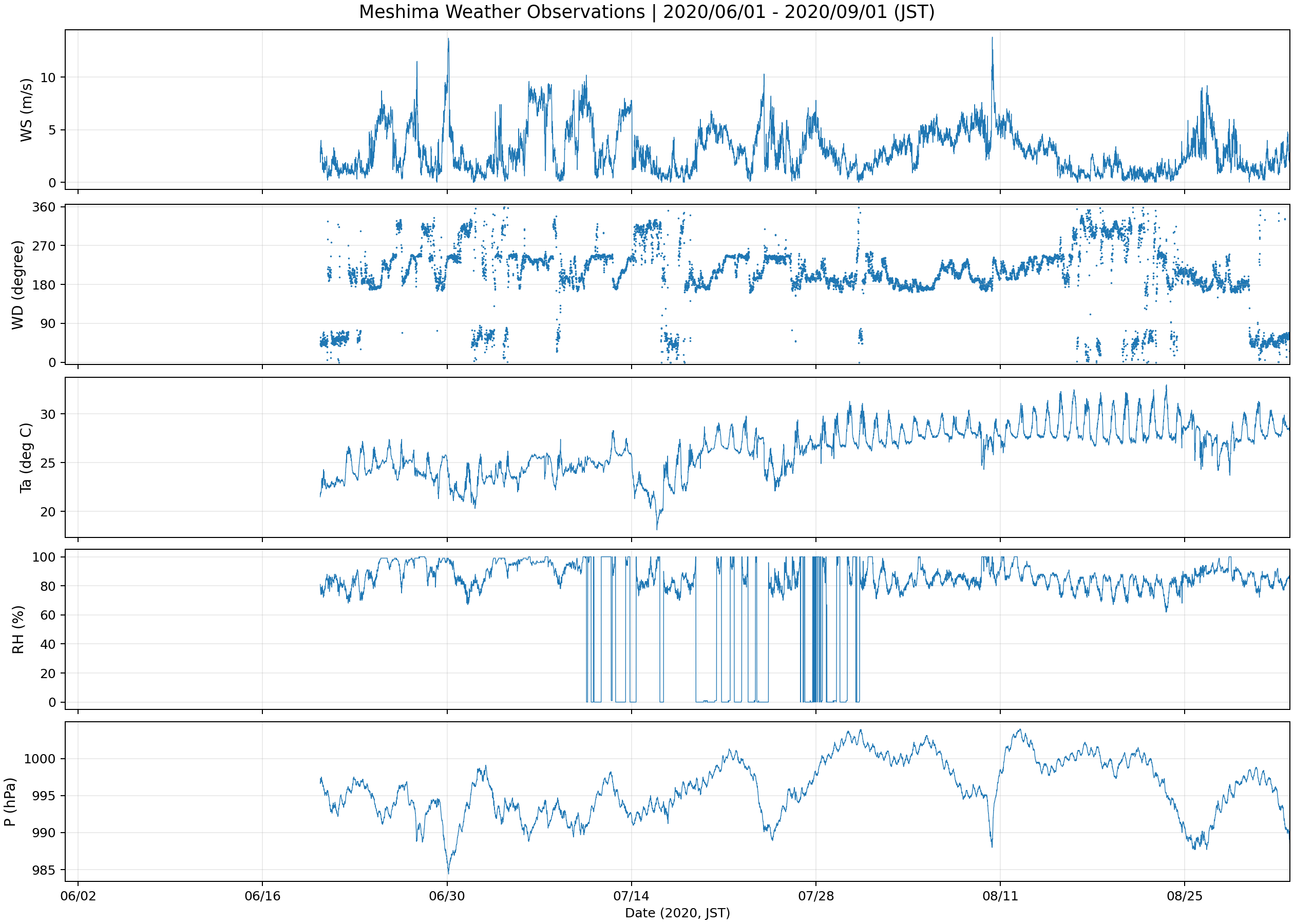
女島で観測された気象データ(風速・風向・気温・湿度):2020年6/1〜9/1
Meteorological Data Observed at Meshima Island (Wind Speed, Wind Direction, Temperature, and Humidity): June 1–September 1, 2020
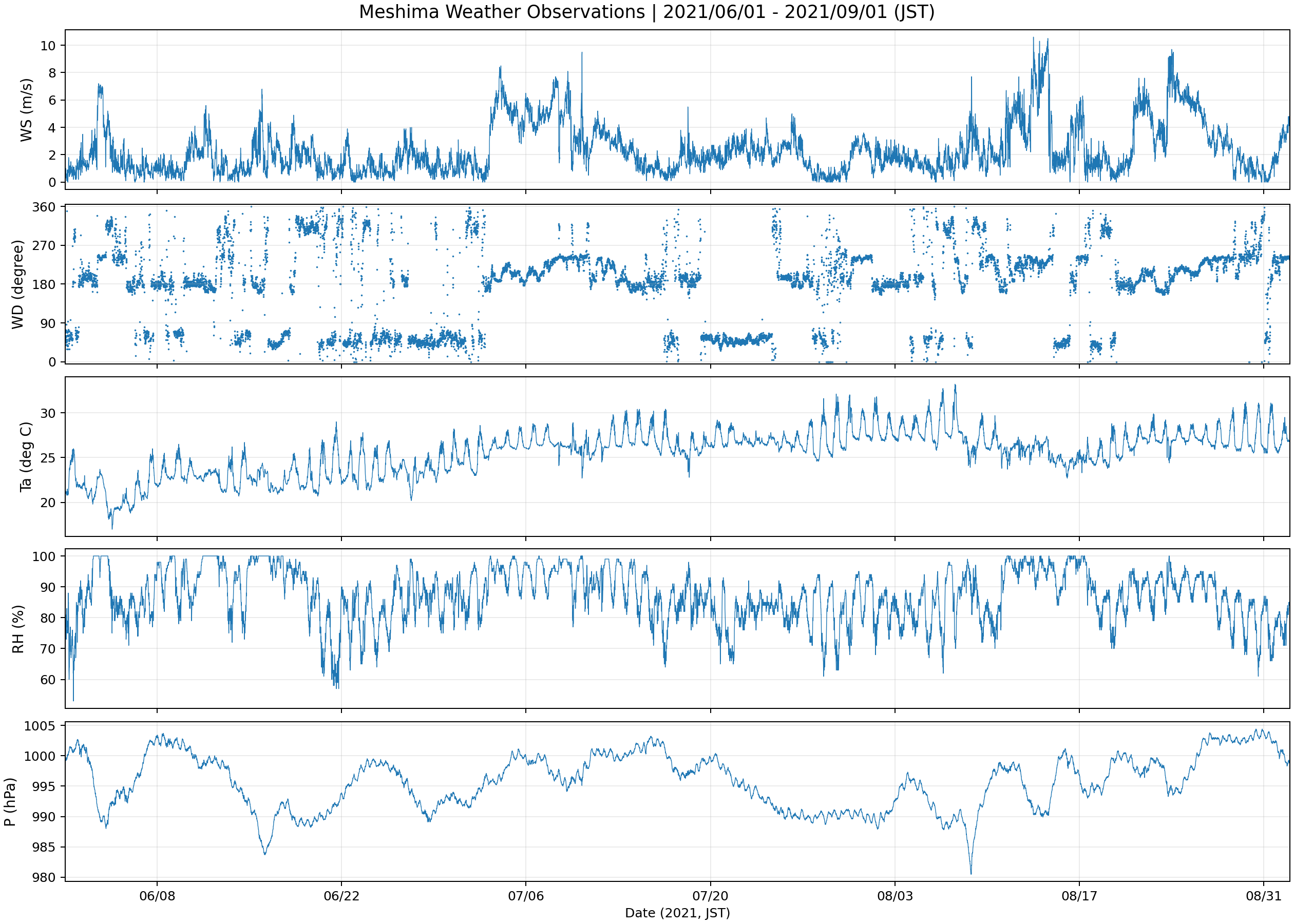
女島で観測された気象データ(風速・風向・気温・湿度):2021年6/1〜9/1
Meteorological Data Observed at Meshima Island (Wind Speed, Wind Direction, Temperature, and Humidity): June 1–September 1, 2021
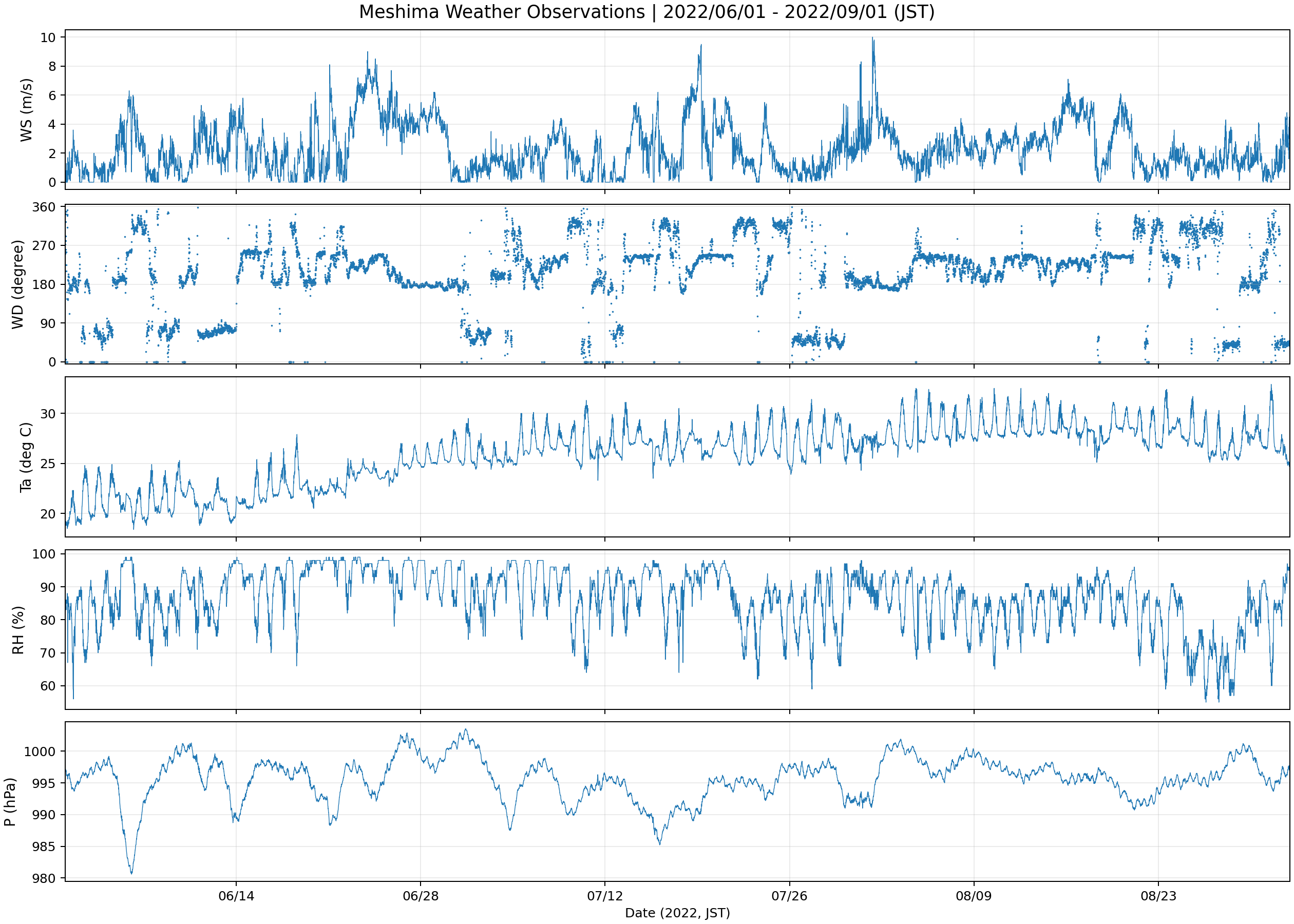
女島で観測された気象データ(風速・風向・気温・湿度):2022年6/1〜9/1
Meteorological Data Observed at Meshima Island (Wind Speed, Wind Direction, Temperature, and Humidity): June 1–September 1, 2022
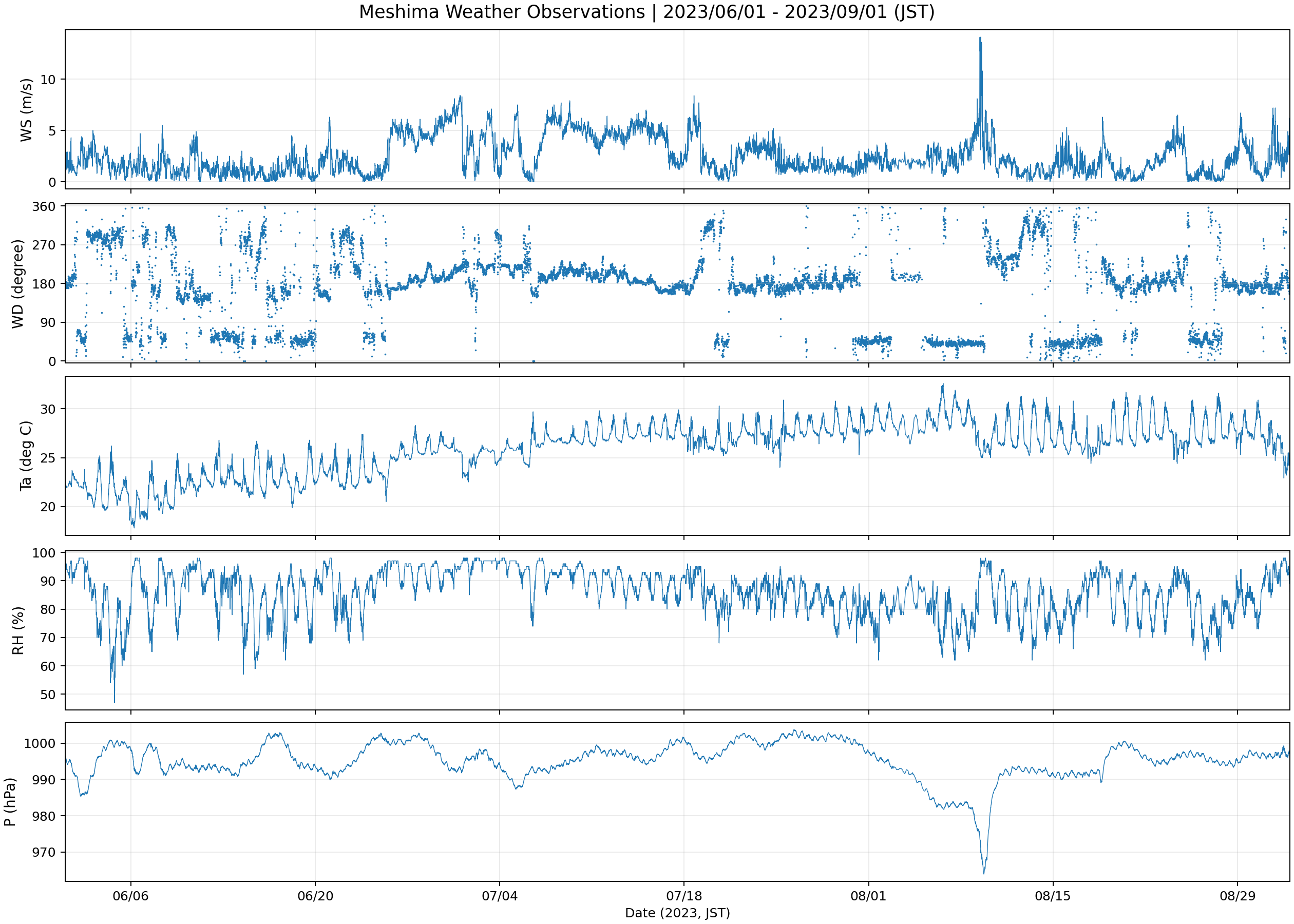
女島で観測された気象データ(風速・風向・気温・湿度):2023年6/1〜9/1
Meteorological Data Observed at Meshima Island (Wind Speed, Wind Direction, Temperature, and Humidity): June 1–September 1, 2023
データのダウンロードはこちら(Download the data here.)→MESHIMA_Weather_Jun01_Sep01.xlsx(2)